A precise operation for a specific problem. Partial knee replacement is not a smaller version of total knee replacement—it is a different operation, meant only for patients with arthritis limited to one compartment of the knee.
Our surgeons performing consistently well makes us too much trustworthy.
100% accuracy with high reliability rate, care, safety and excellence.
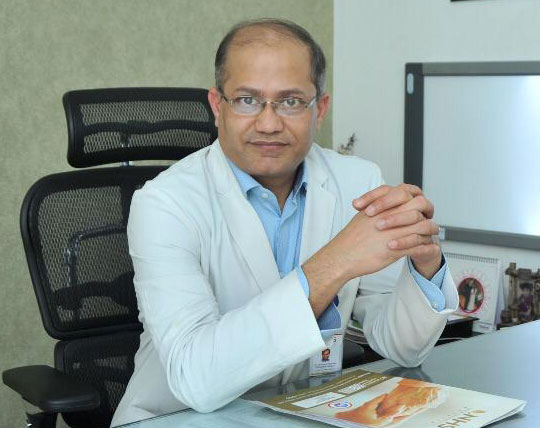
Dr. Shubhang Aggarwal is one in the top 11 robotic surgeons in india.

When used in the right patient, partial knee replacement can provide:
Faster recovery – Get back on your feet sooner
Better knee function – Preserve natural movement
More natural movement – Maintain your knee's mechanics
When used in the wrong patient, it can fail early. This is why correct diagnosis and patient selection are more important than the technique itself.
In partial knee replacement:
Only the damaged compartment of the knee is replaced
The healthy cartilage, ligaments, and bone are preserved
The knee's natural mechanics are maintained
Unlike total knee replacement, the goal is restoration, not substitution.
A healthy knee does not move in a straight mechanical axis. It moves according to each person's natural anatomy and ligament balance—this is known as kinematic alignment and kinematic balancing.
Instead of forcing the knee into a "standard" alignment, kinematic balancing aims to:
Respect the patient's original joint line
Preserve native ligament tension
Maintain physiological movement patterns
Most of the knee remains untouched
The preserved ligaments continue to guide motion
The implant must work with the natural knee, not override it
When performed with proper kinematic principles, UKR often feels:
Smaller incision, less muscle and soft tissue disruption, reduced blood loss.
Many patients are discharged earlier than with total knee replacement. Faster mobilisation.
Quicker return to walking, earlier resumption of routine activities, less post-operative stiffness.
Cruciate ligaments are retained. Movement often feels more natural than a total knee replacement.
Patients usually regain a higher level of confidence in daily movement. Squatting, stairs, and routine activities often feel easier than after total knee replacement (within medical guidance).
You may be suitable for partial knee replacement if:
Arthritis is confined to one compartment of the knee (most commonly the medial compartment)
Ligaments are intact and functional
Knee deformity is mild and correctable
You have good range of motion
Pain is localised to one side of the knee
In such patients, UKR can provide excellent long-term function when done properly.
Partial knee replacement is not appropriate if:
Arthritis affects multiple compartments
There is significant ligament instability
Severe deformity or stiffness is present
Inflammatory arthritis (e.g., rheumatoid arthritis) is the primary diagnosis
Knee pain is diffuse and not localised
In these situations, a total knee replacement or other treatment is more reliable.
Imaging alone does not decide treatment.
A proper decision requires:
Correlating X-rays and scans with clinical symptoms
Identifying the exact source of pain
Assessing ligament integrity and joint mechanics
Partial knee replacement demands precision in diagnosis, not just surgical skill. This is where experience and academic understanding matter most.
Robotic systems can be particularly valuable in UKR because they help with:
Accurate bone preparation
Reproducing the planned joint line
Maintaining kinematic balance
Ensuring precise implant positioning
When used appropriately, robotics supports the principles of kinematic alignment, helping the surgeon execute the plan with greater consistency.
However, robotics does not replace decision-making. It refines execution after the correct surgical plan is established.
Partial knee replacement is not "better" than total knee replacement for everyone.
It is better only for the right patient.
The decision depends on:
Pattern of arthritis
Knee stability
Functional needs
Long-term expectations
A well-chosen total knee replacement will outperform a poorly chosen partial knee replacement.
Because much of the knee is preserved:
Walking usually begins early
Physiotherapy progresses faster
Muscle strength returns sooner
Overall recovery is often smoother
However, structured rehabilitation remains essential.
A minimally invasive surgery still requires maximal commitment to recovery.
is a leading Robotic Knee Replacement Surgeon in India and is One of the Few Surgeons in the country. Only a handful of centres across the Asia Pacific have this revolutionary Robotic Cutting Edge Technology.
With an experience of more than 22+ years and more than 25000+ joint replacement surgeries under his belt, he is the first choice in this part of the country for such complex knee joint medical procedures.
He has advanced training in joint replacement from prestigious medical colleges and universities in the UK, France, Germany, Australia, and Singapore.
Partial knee replacement is a precise, elegant operation when used for the correct indication.
It offers:
Minimal invasiveness
Faster recovery
Preservation of natural knee function
Fewer activity restrictions
But its success depends entirely on:
Correct diagnosis
Proper patient selection
Kinematic understanding of the knee
Surgical experience
This is not a surgery to be offered routinely—it is a surgery to be offered responsibly.
If you have been advised knee replacement and want to know whether a partial knee replacement is appropriate in your case, a detailed clinical evaluation can clarify the best option.
The aim is not simply to operate, but to choose the right operation for the right knee.
When performed on appropriate patients, partial knee replacements can last 15-20 years or more. Success depends heavily on proper patient selection and surgical technique.
Generally yes. Because less bone and soft tissue are affected, patients typically experience less postoperative pain and faster functional recovery.
Many patients return to low-impact activities like swimming, cycling, and walking. High-impact activities should be discussed with your surgeon based on your specific case.
Most patients begin walking within 24-48 hours after surgery. Full recovery typically takes 6-12 weeks, compared to 3-6 months for total knee replacement.